


This is great to see impactful changes such as these! Aside of size of bundle did you measure the improvements on the FCP metrics you can share? You have a 5min max-age on the startup bundle, have you thought about using SWR? @shubhie @RickByers
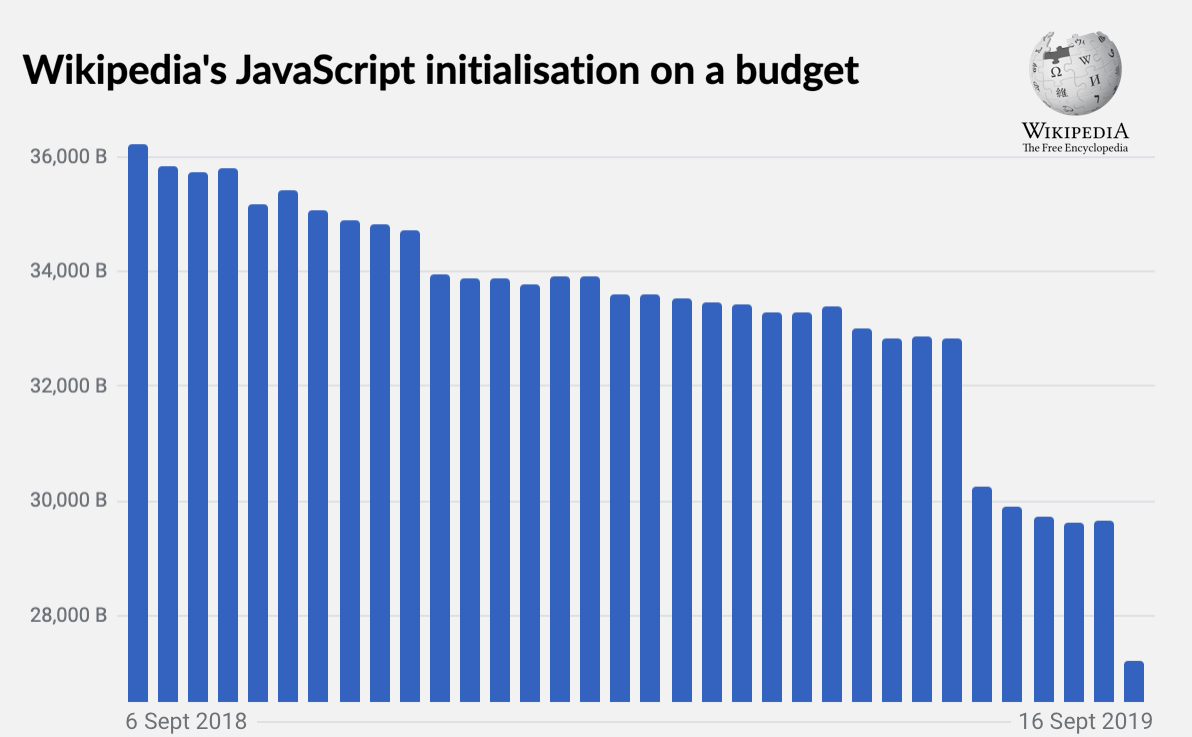
This week we finished a year-long effort that's saving @Wikipedia readers over 4.3 Terabytes of data bandwidth every day!
Thanks @AmirSarabadanii, @Catrope, and many others.
For the technical how and why  https://w.wiki/8bA pic.twitter.com/WzhGyXXWzi
-
-
-
Hi! Couldn't get good measures due to coinciding regressions… Perf improved through the year, but too much noise & other perf work to correlate. SWR: long ago, time to revisit! Reopened old ticket. Thanks! https://phabricator.wikimedia.org/T132418 RE max-age compromise: https://w.wiki/8do
Slut på konversationen
Ny konversation -
-
-
This equates roughly to 30.4 (!) tons of CO2, every day. What equates to a 159.805km (4x around the globe) long gasoline-driven car-trip (with 8l/100km). \o/
#errata thanks to@brightbyte According to -
According to https://www.carbonfootprint.com/calculator.aspx , that's equivalent to flying 20 people from Berlin to San Francisco and back. Which has interesting implications: if flying a team of engineers around the globe makes this happen only one day sooner, it's a net win. Huh.
-
That’s incredible - where does that calculation of TB = CO2 come from?
-
Ops, I missed the source for that in the errata, the assumption is 15.6lb per Gigabyte traffic:https://alistapart.com/article/sustainable-web-design/ …
Slut på konversationen
Ny konversation -
-
-
Der Code der Wikipedia wurde optimiert. Die Benutzer sparen unglaubliche 4,3 Terabyte Datendownload jeden Tag.
-
How much in savings does this represent ?
-
30.4 metric tons CO2 per day says
@wetterfrosch -
How much does this safe on the WMF side and what is the approximation of the savings of transport and the user side.. in dollars
-
This calculation is based on the assumption that the "transport" of a gigabyte takes 13kWh in the US, including servers & ISPs but not customer premesis side (please question these figures), see https://alistapart.com/article/sustainable-web-design/ … and https://web.archive.org/web/20150315045939/http://evanmills.lbl.gov/commentary/docs/carbonemissions.pdf …
-
The source for that 13kWh figure is a study from 2008 though, so the internet could have gotten more energy-efficient in the meantime
-
Let's hope so. But keep in mind that "the Internet" became more mobile on the (not-included) customer side since then. The quoted paper states up to five times more emission for 3G/4G-connections.

-
(ok this is probably about comparing apples with pairs as I have no clue on modem vs. 3G/4G energy-consumption so far)
Slut på konversationen
Ny konversation -
-
-
"A truncated graph (also known as a torn graph) has a y axis that does not start at 0. These graphs can create the impression of important change where there is relatively little change. Truncated graphs should not be used" https://en.wikipedia.org/wiki/Misleading_graph#Truncated_graph …
- 1 mer svar
Ny konversation -
-
-
Hey, that's nice work, Timo!
Tack. Twitter använder detta för att förbättra din tidslinje. ÅngraÅngra
-
-
-
I saw this on hacker news today awesome stuff man!
Tack. Twitter använder detta för att förbättra din tidslinje. ÅngraÅngra
-
-
-
Great job!!
Tack. Twitter använder detta för att förbättra din tidslinje. ÅngraÅngra
-
-
-
Shouldn't it be even more? According to the site you linked, it's 15.6 lb (7kg) of CO2 per GB (or 7 tons per TB). Times 4.3TB, that is 30 tons of CO²! Am I missing something?
-
...according to https://www.carbonfootprint.com/calculator.aspx , that's the equivalent of 100 people flying from SFO to JFK. Every day. Wow. Is my math off somewhere?
Slut på konversationen
Ny konversation -


Hämtningen verkar ta ett tag
Twitter kan vara överbelastat eller ha tillfälliga problem. Försök igen eller besök Twitter Status om du vill ha mer information.