
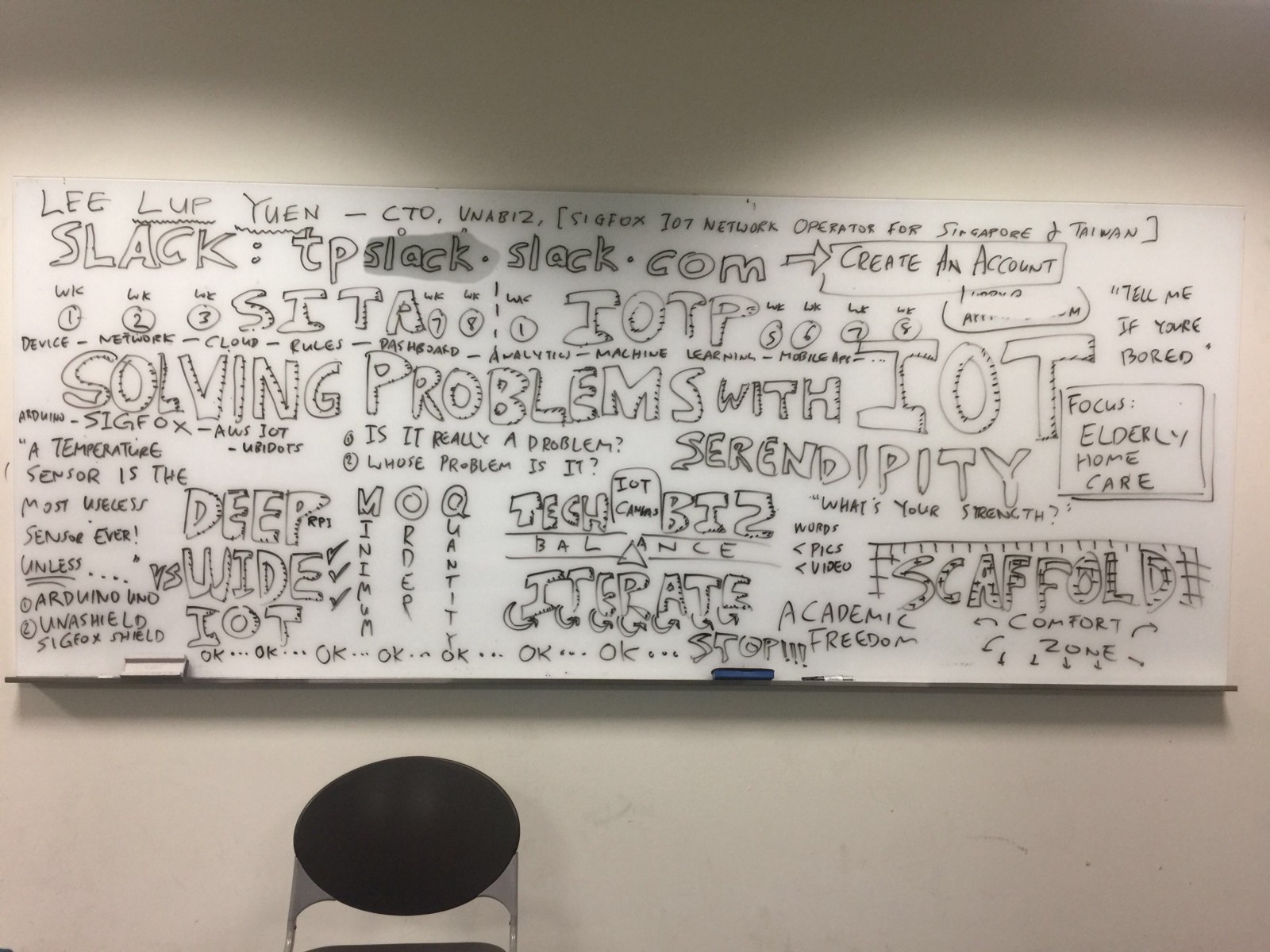
I Teach IoT. Here’s what you’ll learn
I’m taking a break from my day job to focus on my evening teaching job at Temasek Polytechnic. Few have heard about our Specialist Diploma in IoT programme, so please allow me to share what it’s about…
This subject equips students with the knowledge and skills to apply design techniques when designing an Internet of…www.tp.edu.sg
Q: Who is this course for?
A: My students are typically working professionals with day jobs. We meet at Temasek Polytechnic once a week, say Thursday evenings 7pm to 10pm.
There are hands-on practicals / projects that my students can do away from campus. I’m usually available weekends on Slack to help with problems.
Q: My programming skills are rusty. Is this course right for me?
A: Yes! I appreciate a mix of tech and business professionals in my class. You will discover hands-on what IoT is about, and what you must do to reap the benefits of IoT the right way. Even if you don’t plan to get a job in IoT.
I always appreciate the diversity of students in my class. Every cohort brings together people from different backgrounds and domains. I love the challenge of solving IoT problems in every domain.

Q: How long is the course?
A: It’s roughly a year long (32 academic weeks) with breaks in between. The first 16 weeks (one evening each week) focuses on the theory of IoT, with hands-on exercises on a friendly Raspberry Pi.
After a short break we dive deep into the final 16 weeks when the real fun begins! I’ll be your lecturer / drill sergeant to push you through a real-life implementation of IoT in the final project.
Generally I don’t accept projects on imaginary problems. It must be a topic that brings benefits to real people. And you will have to conduct interviews to prove that somebody enjoyed the benefits of your IoT solution.
Q: What tools are used in the projects?
I’ll be teaching all the skills you need to build your minimum viable IoT product:
- Arduino Uno and the Arduino Web Editor
- Low Power Wide Area Network (like Sigfox)
- Amazon Web Services IoT (rules, alerts, Lambda functions, API Gateway, MySQL)
- thethings.io or Ubidots (dashboards)
- Prometheus (time series database)
- And other skills too if your project requires them: mobile apps, machine learning, GIS, …
I have carefully constructed the scaffolding around these tools to make sure you won’t fall into buggy traps. All the code is available online: https://github.com/lupyuen

Q: Where can I get a cheap sturdy box to keep my IoT gadgets? Or mount them outdoors?
A: Try Daiso!

Q: What other options are there for learning IoT?
A: Plenty! I have had the privilege of working with my fellow IoT lecturers at Republic Polytechnic, Singapore Polytechnic, Ngee Ann Polytechnic, Singapore Management University, Institute of Technical Education, ….
Each learning institution provides a different spin on IoT – some are more heavy on sensors and engineering, while others go deeper into cloud and analytics. Temasek Polytechnic has another diploma in Industrial IoT that’s engineering-focused.
I tend to hit straight on solving real-world problems. Yes it’s harder to solve these problems because of the sheer breadth of technologies and issues involved, but I’m keen to show you how we could produce a measurable outcome at the end of the 32-week course.
