Twitter Transparency Report

This initial Twitter Transparency Report includes data from January 1, 2012 through June 30, 2012. We'll be updating this information twice a year. 

User Information Requests

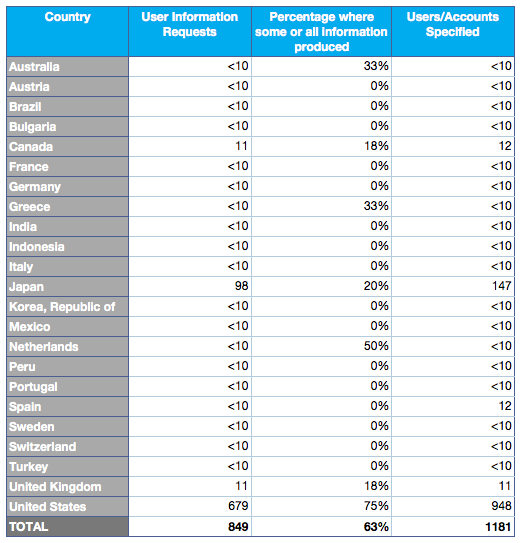
This data includes government requests we’ve received for user account information, typically in connection with criminal investigations or cases.

  • We notify affected users of requests for their account info unless we’re prohibited by law.
  • To minimize potential risk to ongoing investigations, we're not including specific numbers for countries where we've received fewer than 10 requests; instead you’ll see '<10' in the relevant cells.
    • Same holds true for number of 'Users/Accounts specified' – to minimize potential risk to our users, we’re not including specific numbers where fewer than 10 'Users/Accounts specified' are affected; instead you’ll see ‘<10’ in the relevant cells. 
  • 'Users/Accounts Specified' includes the accounts identified in government requests we’ve received, and may include the same account being requested more than once or requests for accounts that do not exist or were misidentified.
  • We may not comply with every request for a variety of reasons. For example:
    • We do not comply with requests that fail to identify a Twitter user account.
    • We may seek to narrow requests that are overly broad.
    • In other cases, users may have challenged the requests after we've notified them.

Removal Requests

This data includes formal government requests we've received to remove or withhold content on Twitter. Governments generally make removal requests for content that may be illegal in their respective jurisdictions. For example, a government agency may obtain a court order requiring the removal of defamatory statements or law enforcement may request us to remove prohibited content.

  • The data does not include reports of Rules violations submitted through our Help Center, informal requests submitted via email, or copyright-related requests.
  • Each request may identify multiple items to be removed.
    • For example, a single request may ask us to remove individual Tweets or an entire user account.
  • 'Users/Accounts Specified' includes the number of accounts identified in the government requests we’ve received.
    • To minimize potential risk to our users, we’re not including specific numbers where fewer than 10 'Users/Accounts specified' are affected; instead you’ll see ‘<10’ in the relevant cells.
  • We may not comply with every request for a variety of reasons. For example:
    • We do not comply with requests that fail to identify content on Twitter.

    Copyright Takedown Notices

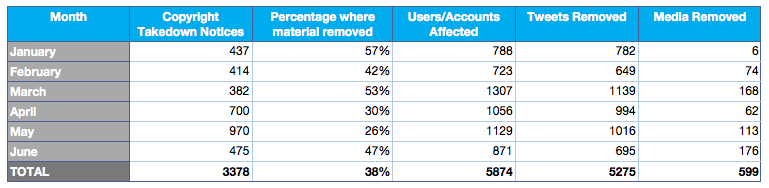
    This data includes reports of alleged copyright infringement submitted through our web form or otherwise sent to us (e.g., fax).

    • The Digital Millennium Copyright Act (“DMCA”) outlines the statutory requirements necessary for formally reporting copyright infringement (i.e., DMCA takedown notices), as well as providing instructions on how an affected party can appeal a removal by submitting a compliant counter-notice.
    • 'Users/Accounts Affected' includes all accounts where content has been removed in response to a valid DMCA takedown notice. 
      • Each user was notified of the takedown request and subsequent action, and provided with instructions on how to file a counter-notice if they believed the content was removed in error. 
    • 'Tweets Removed' Includes all Tweets identified and subsequently removed in response to valid DMCA takedown notices.
    • 'Media Removed' Includes backgrounds, avatars, and Twitter-hosted media (e.g., pic.twitter.com) identified and subsequently removed in response to valid DMCA takedown notices. 
    • We may not comply with every request for a variety of reasons. For example:
      • We do not comply with takedown notices that fail to provide sufficient information for us to locate material on Twitter.
      • We also receive a large number of misfiled, non-copyright complaints through our web form.
        • We carefully review each report received, and follow-up with the reporter as appropriate.

    NOTE: The information above is as accurate as possible, but is not 100% comprehensive.